

Why Luxury Brands Are Entering Real Estate: The Rise of Branded Residences
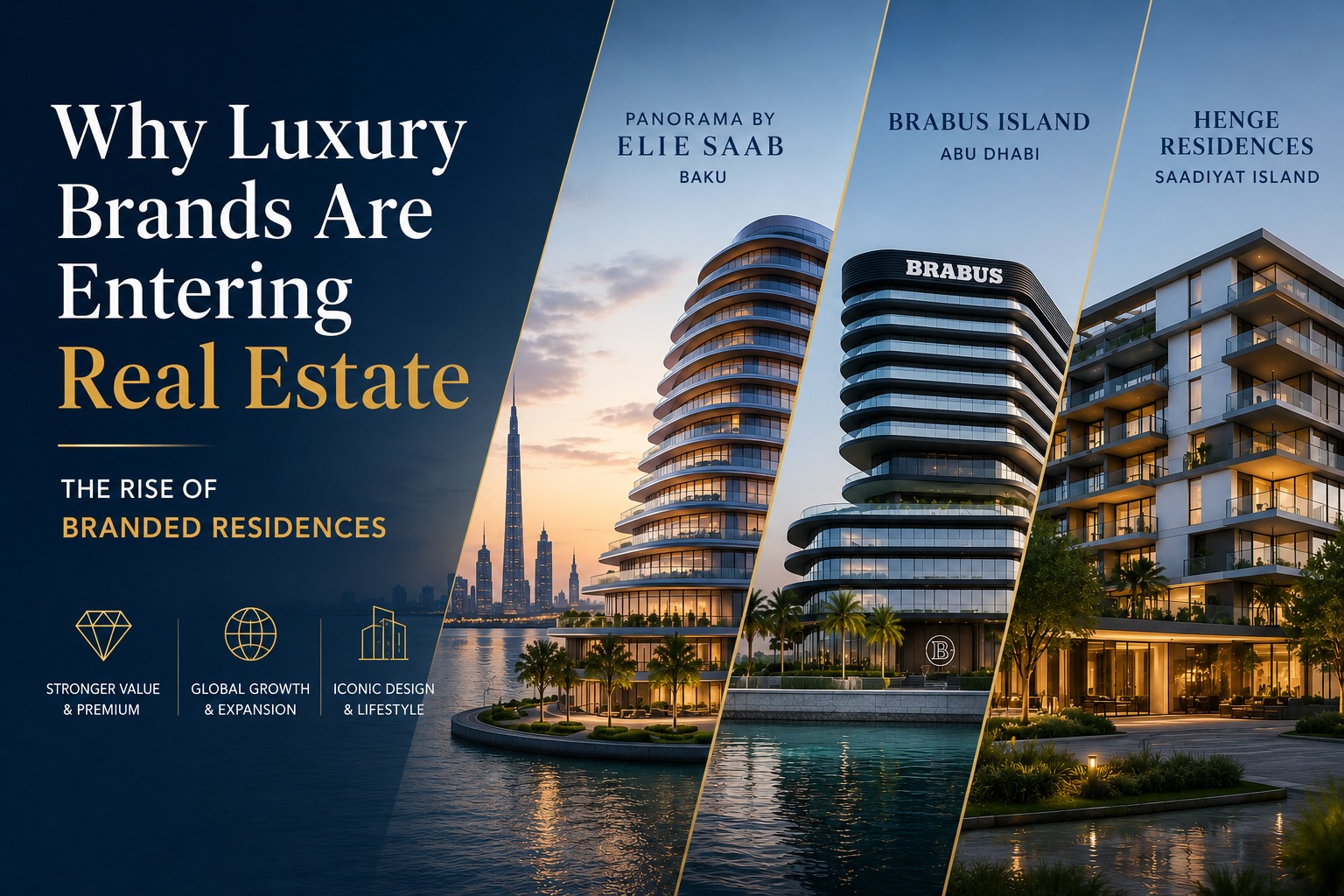
A decade ago, “branded residences” mostly meant an apartment tower with a five-star hotel operator’s name on the lobby. Today, the same label increasingly describes homes designed by a fashion house, engineered around an automotive brand’s design language, or furnished according to a heritage furniture maker’s philosophy. The shift is not cosmetic — it reflects a fast-maturing global asset class that developers, investors, and design studios can no longer treat as a niche.
At Pooleng, an Italian architecture and engineering studio operating since the 1970s, this shift isn’t theoretical. We’ve served as the architectural partner behind three of the sector’s most talked-about non-hotel branded developments: Panorama by ELIE SAAB in Baku, BRABUS Island in Abu Dhabi, and the design language behind Henge Residences in Saadiyat Island. This article breaks down why the branded residences market is growing so quickly, why brands outside hospitality are entering it, and what actually makes these projects succeed at the design and delivery stage.
What Are Branded Residences?
Branded residences are private homes — apartments, villas, or towers — developed in official partnership with a recognized brand, which lends its name, design identity, service standards, or lifestyle philosophy to the property. Historically dominated by hotel groups (Four Seasons, Mandarin Oriental, Ritz-Carlton), the category now spans fashion houses, automotive marques, and furniture and design brands, each translating their identity into architecture, interiors, and amenities rather than hospitality service alone.
The Numbers: How Big Is the Branded Residences Market?
The growth trajectory is one of the clearest in global real estate. According to Savills’ Global Residential Development Consultancy, the branded residences sector held just 323 schemes worldwide in 2015. By the end of 2025, that number is set to reach roughly 910 completed developments — nearly triple in ten years, representing a compound annual growth rate of about 10.9%, a pace that outstrips both the global hospitality and real estate sectors over the same period.
The pipeline is even more telling. Savills reports 837 additional projects already contracted through 2032, which would bring the global total to 1,747 branded residences, spread across more than 90 countries. Twenty-five countries brought their first branded residential project to market in 2025 alone.
Regional growth is reshaping where this asset class lives. Asia Pacific has expanded 55% over five years, led by Vietnam, Thailand, and India, while the Middle East and North Africa region has surged 187%, driven largely by Dubai and the wider Gulf. Savills projects that by 2032, no single region will hold more than a quarter of global supply — a sign the category is globalizing rather than clustering around a handful of hotspots.
The financial case is just as strong. Savills’ own 2025/26 report places the global average price premium for branded residences at 33%, with resort locations reaching as high as 39% above non-branded equivalents in the same market — a figure broadly in line with the 20–35% range that industry commentary has separately attributed to Knight Frank research. Beyond pricing, branded residences also tend to see stronger resale value and faster absorption rates, which is precisely why developers are willing to pay for a brand partnership rather than build unbranded.
Why Are Fashion, Automotive, and Design Brands Entering Real Estate?
For years, hotel operators dominated the branded residences model because they already had the infrastructure — service standards, loyalty programs, global recognition — to layer onto a residential product. Marriott and Accor still lead the sector by scale today, and Four Seasons remains the most influential single luxury hospitality brand, closely followed by Mandarin Oriental and Aman.
But the more interesting story, according to the Savills 2025/26 report, is the rise of the non-hotel category as one of the sector’s genuine creative engines. Brands like YOO, Pininfarina, Armani, Missoni, Fendi, and ELIE SAAB are each translating a distinct design or lifestyle identity into residential form — and Savills expects fashion, automotive, and design-led brands to take an even more prominent role in shaping the sector by 2030.
This isn’t a passing trend; it’s a structural shift in how brands extend their identity. A fashion house’s residence isn’t selling hospitality — it’s selling an aesthetic philosophy, translated into floor plans, material palettes, and shared spaces. This is exactly where the execution risk (and opportunity) concentrates, because a brand’s creative vision has to be translated by an architecture and engineering team that can carry it through permitting, structural design, and construction without losing what made the brand distinctive in the first place.
What It Actually Takes to Build a Branded Residence: Lessons from Pooleng’s Portfolio
A brand can supply the name, the aesthetic, and the story. It cannot, on its own, resolve structural loads, local permitting requirements, façade engineering, or construction sequencing across an international site. That gap — between brand vision and buildable architecture — is where Pooleng has built its role in this sector over the past five decades, working alongside international architects, developers, and brand houses on urban, residential, and civil engineering projects across Italy and abroad, including offices and project work in the UAE, Bulgaria, and beyond.
Three current projects in Pooleng’s portfolio illustrate what that partnership looks like in practice:
Panorama by ELIE SAAB — Baku, Azerbaijan. Developed by Sabah Investment Group in joint venture with Reportage Group, Panorama by ELIE SAAB is Azerbaijan’s first branded residential development that isn’t tied to a hotel or apart-hotel model, and the first project to bring the ELIE SAAB Maison aesthetic to the Caspian Sea. Pooleng was named as the architectural concept partner for the project, working within the Sea Breeze master-planned community to deliver a tower of nearly 580 residences — from one-bedroom apartments to a signature penthouse — designed around ELIE SAAB’s language of light, comfort, and spatial balance. The contract between the brand and developer runs for 25 years, underscoring how long these design partnerships are built to last.
BRABUS Island — Abu Dhabi, UAE. Described on Pooleng’s own project page as the largest branded residence project in Abu Dhabi in 2025, BRABUS Island applies BRABUS’s “one-second-wow” design philosophy — the German performance-automotive brand’s ethos of instant visual impact — to residential architecture. The BRABUS Island project centers on a single roundabout surrounded by four towers and roughly 100 villas, translating automotive precision and sculptural form language, more commonly seen on a supercar, into livable architecture on Abu Dhabi’s waterfront.
Henge Residences — Saadiyat Island, Abu Dhabi. Developed by Nord Lifestyle Development, Henge Residences brings the Italian furniture and design house HENGE’s material philosophy — aged wood, natural stone, brushed metals, and bronze-tinted glass — into a residential façade and interior language for the first time in the region, on one of Abu Dhabi’s most prestigious cultural sites near the Louvre Abu Dhabi.
Across all three, the pattern is consistent: the brand defines the identity, and the architecture and engineering partner defines the execution — structural systems, façade engineering, unit mix, and construction logistics — without diluting what the brand promised buyers in the first place.
What Developers and Brands Should Look for in a Design & Engineering Partner
Based on what separates a well-executed branded residence from a diluted one, a few criteria stand out:
- A track record translating brand identity into buildable architecture — not just renderings, but structural and façade systems that hold up the design intent through construction.
- Cross-border regulatory experience — branded residences increasingly launch in new markets (Azerbaijan, Vietnam, the Gulf) where permitting, codes, and construction norms differ from the brand’s home market.
- Integrated design and project management — coordinating architecture, structural engineering, and construction management under one accountable team reduces the risk of the brand’s vision getting lost between design and delivery.
- Direct experience with non-hospitality brand partners — fashion, automotive, and design houses think about space differently than hotel operators do, and a partner who has already navigated that translation (as with ELIE SAAB, BRABUS, and HENGE) carries less execution risk into a new project.
- Certification and accreditation — quality certifications (such as ISO 9001) and accreditation for internationally financed projects signal a studio built for institutional-grade delivery, not just striking concepts.
Final Thought
Branded residences have moved past being a hospitality side project. They’re a global, fast-growing asset class shaped increasingly by fashion, automotive, and design brands looking to give their identity a physical, livable form. For developers and brands weighing this path, the partnership that matters most isn’t only with the brand — it’s with the architecture and engineering studio that can carry that brand’s identity from concept through construction without compromise.
Pooleng has done exactly that across Baku, Abu Dhabi, and Saadiyat Island. Explore our portfolio or get in touch to talk about your next branded development.